Sunday, June 13, 2010
My Persian weblog
This will be my new weblog in Persian (here). I named it "comet". Later, I'll explain this appellation. In the present blog I will continue my notes in English.


Sunday, April 25, 2010
Chaos, Iran and terror
One thousand years ago, Ferdowsi, the Iranian poet said: “On the ant bearing the grain bring not strife, he is alive and joyous is sweet life”.

It has been the core of the Iranian culture. Of course Iran is not just the political territory which is now known as the country of “Iran”. Iran has been an old continent whose history is rooted in thousands of years ago. Its geographic position is from the east of the Mediterranean Sea, to the west of china. Nowadays much of this territory is called “Middle East”. Aside from the fact that this expression is biased and not scientific, we should note that the present situation does not represent the main characteristics of this land.
Iran has been the intersection point of “The west” and “The east”. So, Iran is neither eastern nor western. Neither the rational individualistic characteristics of The West, nor the irrational theosophical tendencies of The East, describe it correctly. Both of them represent themselves in it. I think this is the most important advantage of the Iranian culture. But at the same time this property made the society vulnerable. Iran between Western, Eastern and Arabian powers, had the unique position as the bridge of civilizations. Chaos appeared in Iran as a result of invasion of three major powers: Greeks, Arabs and Mongols. I have previously discussed about chaos in Iran.
In the last decades there have been a lot of conflicts and wars in the Iranian lands. In “Afghanistan” (as you know, it was a part of Iran before its separation with the cooperation of a freemason called Mirza Aghakhan Nouri and the British government) the presence of the above mentioned three major forces is obvious: the eastern communism with the direct role of Russia, the Arabic-Islamic fundamentalism and finally the American invasion. Many western citizens may accuse the Iranian culture for the recent terrorism in “Afghanistan”, but we should make it clear that these terrors have appeared as a result of the chaotic situation imposed by Russians, Americans and Arabs. No one can ignore the role of the US government in generating Islamic fundamentalism in the Iranian lands, especially in “Afghanistan”.
One of the American strategists has proposed the US government to help develop chaos in Iran. He thinks that the only way to subordinate the Iranian government is to destroy the foundations of order in the society. This fellow thinks using chaos theory is so easy. It seems that he doesn’t know that the first rule of the chaos theory is that no one can control anything. We must remind him what the external forces have done in the recent centuries. They have done nothing but developing chaos. It is true that in chaos theory, exerting external force always leads to chaos. But when chaos appeared, no one can control it. Thus, we should keep in mind the role of the external forces in emerging terrorism.
The Iranian culture has never admitted terrorism. Saadi, the Iranian poet, expresses it in this way:
Iran has been the intersection point of “The west” and “The east”. So, Iran is neither eastern nor western. Neither the rational individualistic characteristics of The West, nor the irrational theosophical tendencies of The East, describe it correctly. Both of them represent themselves in it. I think this is the most important advantage of the Iranian culture. But at the same time this property made the society vulnerable. Iran between Western, Eastern and Arabian powers, had the unique position as the bridge of civilizations. Chaos appeared in Iran as a result of invasion of three major powers: Greeks, Arabs and Mongols. I have previously discussed about chaos in Iran.
In the last decades there have been a lot of conflicts and wars in the Iranian lands. In “Afghanistan” (as you know, it was a part of Iran before its separation with the cooperation of a freemason called Mirza Aghakhan Nouri and the British government) the presence of the above mentioned three major forces is obvious: the eastern communism with the direct role of Russia, the Arabic-Islamic fundamentalism and finally the American invasion. Many western citizens may accuse the Iranian culture for the recent terrorism in “Afghanistan”, but we should make it clear that these terrors have appeared as a result of the chaotic situation imposed by Russians, Americans and Arabs. No one can ignore the role of the US government in generating Islamic fundamentalism in the Iranian lands, especially in “Afghanistan”.
One of the American strategists has proposed the US government to help develop chaos in Iran. He thinks that the only way to subordinate the Iranian government is to destroy the foundations of order in the society. This fellow thinks using chaos theory is so easy. It seems that he doesn’t know that the first rule of the chaos theory is that no one can control anything. We must remind him what the external forces have done in the recent centuries. They have done nothing but developing chaos. It is true that in chaos theory, exerting external force always leads to chaos. But when chaos appeared, no one can control it. Thus, we should keep in mind the role of the external forces in emerging terrorism.
The Iranian culture has never admitted terrorism. Saadi, the Iranian poet, expresses it in this way:
The ease of two worlds is the explanation of these two words: With friends, kindness; with enemies, courtesy.In 2007, Britsh MPs visiting the Pentagon were shocked to be told by one of President Bush's senior women officials: “I hate all Iranians”. She is absolutely unfamiliar with the Iranian culture and literature. She doesn’t know anything about history as well. If she does, first of all she would hate herself because of the role of her government in destroying the Iranian culture. They are very active in Afghanistan to destroy the Iranian identity of this land. Just look at what is happening at there: a destructive war between Americans and Arabic-Islamic fundamentalists whose roots are in Pakistan. The Iranian culture is exactly against terror. Chaos will not benefit anyone, but terrorists.
Friday, March 19, 2010
An amazing distribution of scores
Today, I found a blog conducted by an Iranian sociology teacher, accidentally. I don’t know him at all. He has put the scores of his students on his blog, so I was motivated to find out how is the range of scores. I was shocked seeing the list! Most of them were lesser than 10 and there were several scores such as 2, 2.5, 3 and so on. It should be noted that in Iran, the range of scores in from 0 to 20. I recommend you to take a look at this teacher’s score list, here.
The title of that course, was “Introduction to sociology”! Are his students extremely weak? Or is he an autocratic teacher? I don’t know. Perhaps none of them, he is may be incapable of teaching sociology, as we can see most of his students has failed the exam.
By contrast, there are teachers in Iran, whose all students pass the exams with scores of more than 16 or 17. The distribution is interesting. I don’t believe that all scores must have the normal distribution, but something that has always been in my mind is the teachers’ self-confidence. Are their means of examination so accurate that leads them to giving such amazing scores?
The title of that course, was “Introduction to sociology”! Are his students extremely weak? Or is he an autocratic teacher? I don’t know. Perhaps none of them, he is may be incapable of teaching sociology, as we can see most of his students has failed the exam.
By contrast, there are teachers in Iran, whose all students pass the exams with scores of more than 16 or 17. The distribution is interesting. I don’t believe that all scores must have the normal distribution, but something that has always been in my mind is the teachers’ self-confidence. Are their means of examination so accurate that leads them to giving such amazing scores?
Tuesday, March 16, 2010
The millennium of Shahnameh
Today, the 16 March 2010 (or 25 Esfand 1388 in Persian calendar), is the 1000th anniversary of completing the Shahnameh. 1000 years ago in such a day, the great task of composing Shahnameh (The book of Kings) ended up by Ferdowsi, after 30 years of working hard.
Shahnameh is one of the main pillars of the Persian language. In fact, its importance is more than this. After the invasion of Arabs (about 1400 years ago) the Iranian identity was in danger of frustration. Arabs destroyed the Egyptian identity and language. They also tried to destroy the Iranian’s identity with the military power for more than two hundred years, but at last they failed to do that, because the Iranian movements recaptured the country.
Ferdowsi’s Shahnameh consists of more than 60/000 verses, narrating the epical history of Iran. One of the stories in Shahnameh in which I’m interested, is the passing of Siavash through the fire. Siavash was a Persian prince who was accused to having a sexual intercourse with his stepmother, Sudabeh. Due to the treason of Sudabeh (with whom he refused to have sex and betray his father), he was obliged to pass through the fire to show his honesty. There was a belief that the fire would not damage the innocents.
Siavash passed through the fire successfully and everyone was convicted with innocence of Siavash. Nonetheless Siavash, despite of his innocence, self-exiled himself to Turan, where he was killed by Afrasiab. At the time of leaving Iran, at the border of Iran and Touran, he stopped the horse and looked at his beautiful land and told goodbye to Iran.
Since that time, and even nowadays Iranians remember their prince, Siavash, by passing through the fire in the last Wednesday of the persian year. This day is called “Charshanbeh Souri”. Siavash is the symbol of honesty, innocence, and peacefully in the Iranian culture. Siavash refused to fight with Turan, the Iran’s enemy. Instead of fighting, he proposed to play wicket. Today, is the 1000th anniversary of Shahnameh and “Charshanbeh Souri”.
Shahnameh is one of the main pillars of the Persian language. In fact, its importance is more than this. After the invasion of Arabs (about 1400 years ago) the Iranian identity was in danger of frustration. Arabs destroyed the Egyptian identity and language. They also tried to destroy the Iranian’s identity with the military power for more than two hundred years, but at last they failed to do that, because the Iranian movements recaptured the country.
Ferdowsi’s Shahnameh consists of more than 60/000 verses, narrating the epical history of Iran. One of the stories in Shahnameh in which I’m interested, is the passing of Siavash through the fire. Siavash was a Persian prince who was accused to having a sexual intercourse with his stepmother, Sudabeh. Due to the treason of Sudabeh (with whom he refused to have sex and betray his father), he was obliged to pass through the fire to show his honesty. There was a belief that the fire would not damage the innocents.
Siavash passed through the fire successfully and everyone was convicted with innocence of Siavash. Nonetheless Siavash, despite of his innocence, self-exiled himself to Turan, where he was killed by Afrasiab. At the time of leaving Iran, at the border of Iran and Touran, he stopped the horse and looked at his beautiful land and told goodbye to Iran.
Since that time, and even nowadays Iranians remember their prince, Siavash, by passing through the fire in the last Wednesday of the persian year. This day is called “Charshanbeh Souri”. Siavash is the symbol of honesty, innocence, and peacefully in the Iranian culture. Siavash refused to fight with Turan, the Iran’s enemy. Instead of fighting, he proposed to play wicket. Today, is the 1000th anniversary of Shahnameh and “Charshanbeh Souri”.
Sunday, January 24, 2010
The phoenixes of my land
In a commentary on a friend’s counseling article, I wrote about the terrible suicide of Iranian women. The initial article, written by Ms. Hedayatnia, was a generic investigation on the matter of suicide. Similar to many others, it had a Durkheimian perspective in which it had been proclaimed a negative correlation between the rates of suicide and the amount of cohesion in the society. You can see our articles in Persian here: mine, hers.
The figures published by the Legal Medicine Organization of Iran show that the highest rates of suicide is affiliated to provinces in which poverty is extensively prevalent. Provinces such as Ilam, Kermanshah and Lorestan are in this category. It may be surprising that these provinces are of the most traditional provinces of Iran with the tribal culture and with the most amount of cohesion between their people.
Isn’t it a disavowal of Durkheim’s theory? I don’t think so. If we go back to few decades behind, the theory would presumably reconcile with the fact. But now, in our times, you can see a lot of young people in such traditional and tribal provinces which have been familiar with modern cultures via different media. They think in a modern way, maybe some of them have high level of education, but at the same time they are obliged to live in the traditional situation of their community.
The situation is particularly more disastrous for women. In the traditional patrimonial cultures dominating these provinces, women and girls are considered as the possessions of their husbands or fathers. A lot of articles and books have been published on these issues (eg. On the girls’ hymen) and I don’t repeat them. What it is important here, is the discrepancy between these women’s expectations and the rough reality in these communities.
The life has lost its meaning for these women. They can’t endure to be treated as slaves while they have another democratic and modern world in their minds.
In Persian literature, phoenix (‘ghoghnous’) is a firebird that:
The figures published by the Legal Medicine Organization of Iran show that the highest rates of suicide is affiliated to provinces in which poverty is extensively prevalent. Provinces such as Ilam, Kermanshah and Lorestan are in this category. It may be surprising that these provinces are of the most traditional provinces of Iran with the tribal culture and with the most amount of cohesion between their people.

Isn’t it a disavowal of Durkheim’s theory? I don’t think so. If we go back to few decades behind, the theory would presumably reconcile with the fact. But now, in our times, you can see a lot of young people in such traditional and tribal provinces which have been familiar with modern cultures via different media. They think in a modern way, maybe some of them have high level of education, but at the same time they are obliged to live in the traditional situation of their community.
The situation is particularly more disastrous for women. In the traditional patrimonial cultures dominating these provinces, women and girls are considered as the possessions of their husbands or fathers. A lot of articles and books have been published on these issues (eg. On the girls’ hymen) and I don’t repeat them. What it is important here, is the discrepancy between these women’s expectations and the rough reality in these communities.
The life has lost its meaning for these women. They can’t endure to be treated as slaves while they have another democratic and modern world in their minds.
In Persian literature, phoenix (‘ghoghnous’) is a firebird that:
“It has a 500 to 1,000 year life-cycle, near the end of which it builds itself a nest of twigs that then ignites; both nest and bird burn fiercely and are reduced to ashes, from which a new, young phoenix or phoenix egg arises, reborn anew to live again.”Women and girls from the least developed provinces of Iran are our nowadays phoenixes. Notice the form of suicide they choose to free themselves: self-burning! They throw themselves in the flames of fire and let their bodies to burn completely and transform to ash. Self-burning is chosen because of its tremendous impression on other people. They want to transmit a message to us by reluming themselves. Their ashes are the seeds of a better tomorrow for my land, Iran.
Thursday, January 14, 2010
In which countries is status inconsistency more prevalent?
 There are a lot of controversial discussions about the consequences of status inconsistency. But in most of the literature it is accepted that this phenomenon has been appeared as a result of the modern patterns of social mobility. Almost all the writers point to the advanced countries to show the importance of the matter. They think that status inconsistency is noticeably more prevalent in advanced countries than the so-called “third world” countries.
This is arisen from a narrow-minded thought that supposes the world consisting of two major parts: the modern western countries and the traditional societies of the “third world”. I have already written about it that some countries such as Iran are neither traditional nor modern. Let me leave this extremely important problem here now, I will return to it more precisely later.
For now, I want to make a very simple comparison between Iran and Canada. I have analysed the correlation between income, education and occupational prestige. The data I have used is taken from the WVS 2000.
As you can see in the preceding picture, the correlation in all the cases is higher for Canada. What does it mean? It is the the most important problem I am going to shed light on.
Thursday, December 31, 2009
The distribution of political orientations
Unlike modern and traditional societies, the lack of a major dominant epistemological structure is evident in Iran. It leads to a lot of social problems that I have discussed and I will return to them in the future. But now let me emphasize in the case of political orientations in Iran.
Iranian Intellectuals’ orientations and attitudes have an essential difference with their western counterparts. The most important characteristic of the political orientations of the western intellectuals is their normal distribution. My experience of living in the Iranian society leads me to conclude that the distribution is not normal in Iran. It may be something like the graph below:
 Of course Germany in those years was a modern society, but it was at the same time non-coherent and fragmented. Historically, the lack of social cohesion and efforts of nationalist movement to unite the society emerged the above-mentioned situation.
I think this is also different from the chaotic distribution of political orientations in Iran in our times. The Iranian distribution model is not polarized, because Iran is not completely modern. The consistency of political orientations in this society is low. Moreover, the lack of solidarity in Iran is not due to the lack of historical national identity. I have pointed it earlier (here) that the national identity has maintained the Iranian society cohesive during tens of centuries and now it can still be a unifying factor. This prevents the polarization of the society.
Data Analysis
I have uses the data from World Values Survey to investigate the accuracy of this claim. The survey measures “self positioning in political scale” in a spectrum from 1 (most leftist) to 10 (most rightist). First of all I have made a comparison between Iran, United States and Canada. US and Canada have been chosen as two of the most developed and modern countries. The following graph shows this comparison.

At first glance, it seems that all of these countries have normal distribution to some extent. But if we pay more attention it will be clear that the only reason for one to think that Iran reconciles with the normal distribution pattern is the amount of respondents to item 5. Analysis of the data from other countries indicates an important point. As you can see in the graph bellow, item 5 is most chosen in all the countries.
Iranian Intellectuals’ orientations and attitudes have an essential difference with their western counterparts. The most important characteristic of the political orientations of the western intellectuals is their normal distribution. My experience of living in the Iranian society leads me to conclude that the distribution is not normal in Iran. It may be something like the graph below:
 The number of radical intellectuals – whose position is at the two ends of the spectrum – is more than the number of moderate and middle oriented intellectuals. One might say that this is the characteristic of all the societies which are in the way of transition. It is true that the transiting societies have not the characteristic of normal distribution during the transition period, but if we want to understand the difference between societies such as Iran and other “transiting societies”, we should elaborate our mean of “transition”.
I have discussed this earlier (here) and I will not repeat it here, but I should mention that in the western transiting societies in 18th and 19th centuries there has been a unifying process which has forced most of the intellectuals to concentrate in some specific points of the spectrum. This process is modernity. In my point of view, modernity, in spite of its diversifying tendencies can also be taken into account as a process of unification. It makes no difference whether you consider it from Durkheim’s functionalist perspective as “organic solidarity” or from the critical perspective of Frankfurt School who saw it as “decline of Individuality” and developing “similarity”. As I have mentioned in the previous posts, modernity in Iran has not been a process.
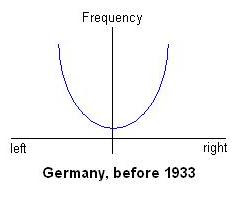
It seems that our conclusion does not apply to some western countries, such as Germany. The downfall of the Weimar Republic and rise of Nazism is precisely the consequence of the lack of normal distribution in the political orientations of German Intellectuals and people. Most of the Intellectuals (and people) were extremely right or extremely left. By 1933 the Communist Party had more than 300,000 members and the National Socialist Party had mobilized a lot of people under its flag. The society had been polarized: the communists and the Nazists.
There were little people in the “middle” to support democracy and rescue the Weimar Republic. This situation can be illustrated as below:
Of course Germany in those years was a modern society, but it was at the same time non-coherent and fragmented. Historically, the lack of social cohesion and efforts of nationalist movement to unite the society emerged the above-mentioned situation.I think this is also different from the chaotic distribution of political orientations in Iran in our times. The Iranian distribution model is not polarized, because Iran is not completely modern. The consistency of political orientations in this society is low. Moreover, the lack of solidarity in Iran is not due to the lack of historical national identity. I have pointed it earlier (here) that the national identity has maintained the Iranian society cohesive during tens of centuries and now it can still be a unifying factor. This prevents the polarization of the society.
Data Analysis
I have uses the data from World Values Survey to investigate the accuracy of this claim. The survey measures “self positioning in political scale” in a spectrum from 1 (most leftist) to 10 (most rightist). First of all I have made a comparison between Iran, United States and Canada. US and Canada have been chosen as two of the most developed and modern countries. The following graph shows this comparison.
At first glance, it seems that all of these countries have normal distribution to some extent. But if we pay more attention it will be clear that the only reason for one to think that Iran reconciles with the normal distribution pattern is the amount of respondents to item 5. Analysis of the data from other countries indicates an important point. As you can see in the graph bellow, item 5 is most chosen in all the countries.
 It does not mean that all the people who have placed themselves at the item 5 are going to represent their political orientation as middle-oriented. Why is the difference between items 5 and 6 so high? I think the most admissible answer is this: At first glance, most of the people think that 5 is the middle of the scale; they choose item 5 because they do not want to take a political orientation. Thus, for a lot of respondents item 5 means “no answer”. For this reason I eliminated the respondents who had chosen item 5. The percentage of these respondents for Iran, United States and Canada is respectively 30.3, 29.1 and 31.9.
 This graph confirms our hypothesis. Unlike US and Canada, Iran has not normal distribution.
To be continued…
Subscribe to:
Posts (Atom)